telco-news
March 26, 2026
Continuing To Bridge the Digital Divide Requires People

Column by: Alisha Pinto, NCSC Senior Energy Industry Analyst
In a moment when headlines are dominated by artificial intelligence, data centers and the escalating demand for high-capacity computing, a quieter but more urgent reality is looming to challenge rural telecom providers: lack of skilled workers to build broadband networks.
Telecom providers—longtime stewards of rural infrastructure—continue to close the digital divide, but they may soon face new challenges to technology upgrades and expansions. While they may have secured financing or grants and be ready to build, the workforce needed to execute these projects is under significant strain.
Telecommunications Workforce in Decline Following 2001 Peak
Number of telecommunications employees in January of each year, in thousands
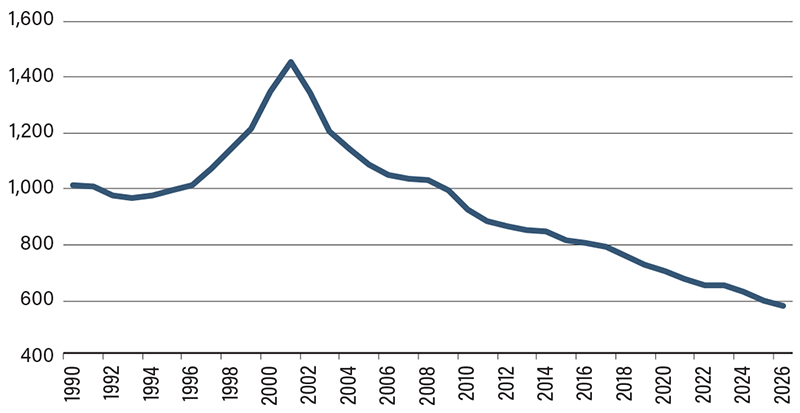
Source: U.S. Bureau of Labor Statistics, Employment, Hours and Earnings from the Current Employment Statistics survey (National), data extracted for January of each year. Data for 2026 is preliminary.
The broadband construction and operations sector relies on a diverse mix of skilled workers, including fiber and wireless technicians, network architects, field engineers and
electricians. Yet, the labor pool for these occupations has been shrinking for more than two decades. Much of the industry’s growth occurred in the 1990s, and today, one in five workers is over age 55, signaling a surge in retirement at the same moment demand is accelerating.
By 2032, a recent Pew Research Center study predicts the industry will need to fill 28,000 broadband construction jobs and 30,000 technician roles, while also replacing 120,000 retiring or departing workers. This widening gap threatens to become one of the most significant bottlenecks in rural broadband deployment.
The federal government’s Broadband Equity, Access and Deployment (BEAD) program is poised to catalyze an unprecedented wave of satellite technology, fiber and wireless infrastructure projects with $42.45 billion of grant financing. But capital alone isn’t enough as every state will require a trained, available and scalable workforce able to build and maintain broadband systems on aggressive timelines.
Without strategic workforce planning, telecom providers risk project delays, cost overruns and missed opportunities to serve their members.
Both electric and telecom cooperatives are uniquely trusted by their members: In an NRECA survey, 60% of electric cooperative members said their local cooperative is their “best trusted broadband partner.”
To fulfill that expectation, all rural utility providers will need to take proactive steps today:
- Forecast workforce needs early. Align staffing plans with fiber buildout schedules and long-term operational requirements.
- Develop local talent pipelines. Partner with vocational schools, high schools, workforce boards and technical colleges to create training programs and apprenticeships.
- Strengthen vendor and contractor relationships. Secure long-term agreements to ensure labor availability and avoid project bottlenecks.
- Leverage regional partnerships. Coordinate with national organizations, statewide associations and neighboring rural providers to share training resources and labor pools.
As telcos expand their roles in delivering connectivity, preparing the workforce becomes a strategic imperative. Existing efforts in programs and certifications are paving the way to bring in new talent.
For example, the Fiber Broadband Association works nationwide with colleges and training institutions, offering courses and certifications for technicians. In Tennessee, the
Tennessee College of Applied Technology (TCAT) supports students with hands-on training and certification, preparing them to enter the workforce.
By investing in talent development now, telecom providers can ensure rural America is not left behind in the digital future and can continue their legacy of bringing essential services to every home and business they serve.